Why Credit Card Companies Are Lending to People With Lower Credit Scores

WHEN A NEW CREDIT CARD FEELS LIKE THE ANSWER
Imagine opening your mailbox and finding an offer for a new credit card.
You're already stretching your paycheck.
Groceries cost more than you expected. The bills keep coming. Christmas is around the corner, and you're wondering how you're going to cover everything.
Then you see it.
You've been approved for another credit card.
Maybe it's a $2,000 limit.
Suddenly, you feel like you have a little breathing room.
You could finally catch up on something you've been putting off. You could buy those Christmas gifts. Maybe you could stop worrying about your checking account for a few days.
And for a moment, it feels like somebody has handed you a solution.
But here's the question I want you to consider.
Is that new credit card helping you solve a financial problem, or is it creating another bill you'll have to pay later?
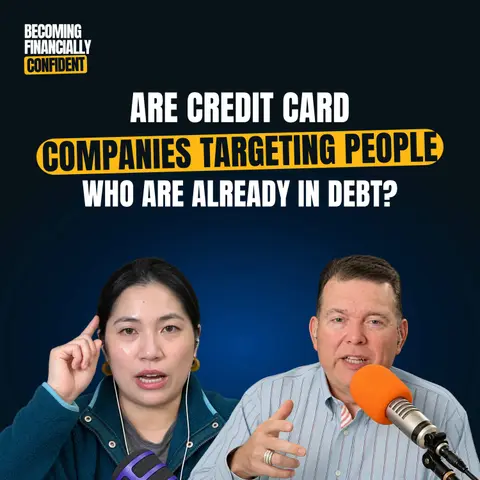
That's the conversation Juliet and I had on Becoming Financially Confident after looking at new credit card lending data.
And what caught my attention wasn't just how many new credit cards were being opened.
It was who was getting access to them.
CREDIT CARD COMPANIES ARE EXPANDING ACCESS TO LOWER-SCORE BORROWERS
According to TransUnion's third-quarter 2026 Credit Industry Insights Report, bankcard originations reached 22.4 million during the second quarter of 2026.
That's an increase of 9.5% compared with the same period a year earlier.
At first glance, that sounds encouraging.
More credit cards being issued could mean more people are gaining access to borrowing opportunities.
But there was something else in the report that caught my attention.
Lenders were expanding credit access to below-prime borrowers, including people with VantageScore 4.0 credit scores of 660 or below.
These are consumers lenders generally consider higher risk.
And according to the report, financial institutions were using approaches such as smaller credit limits and adjusting interest rates to manage that risk.
Now, I want to make something very clear.
Having a lower credit score doesn't mean somebody is irresponsible.
People can have lower scores for all kinds of reasons.
And being approved for a new credit card doesn't automatically mean somebody is already drowning in debt.
But it does raise a question.
What happens when people who may already be financially vulnerable are given easier access to additional borrowing?
That's what worries me.
WHY WOULD CREDIT CARD COMPANIES LEND TO HIGHER-RISK BORROWERS?
Credit card companies are businesses.
They want to grow, serve customers, and earn revenue.
There's nothing inherently wrong with that.
In fact, responsible access to credit can be useful.
But consumers need to understand how the business works.
Credit card companies can earn money from interest charges, certain fees, and transaction-related revenue.
When borrowers carry balances, interest can become a significant expense.
And when people only make minimum payments, repayment can take much longer than expected.
During the show, I asked Juliet to look at this situation from the perspective of the lender.
If you're a lender, what kind of customer generates interest revenue?
One who consistently carries a balance.
Now, that doesn't prove that lenders are deliberately looking for people who can't afford their debt.
But it's still an important part of the conversation.
Because when you're the person receiving the credit card offer, you need to understand that the company offering you the money has its own financial interests.
Their decision to approve you isn't the same thing as determining whether borrowing is the best decision for your household.
That responsibility still belongs to you.
THE REAL COST OF CREDIT CARD DEBT
During the episode, I talked about the cost of carrying a credit card balance.
Let's use a simple illustration.
Suppose you have a balance of $6,678 with a 22% annual percentage rate.
Multiplying that balance by 22% produces approximately $1,469.
That's a simplified one-year illustration assuming the balance stays unchanged, not a prediction of what your actual interest charges will be.
Real credit card interest depends on your daily balances, transactions, payments, and account terms.
Still, the example illustrates something important.
That interest is money you're paying simply because you borrowed.
It's not buying groceries.
It's not paying the electric bill.
And it's not building your savings.
Now imagine carrying that balance while accepting another credit card offer.
You might feel like you have more financial flexibility.
But unless you have a clear plan to repay the debt, you could simply be creating another financial obligation.
And that's why I want consumers to look beyond the credit limit when evaluating an offer.
The question isn't just how much you can borrow. It's how much it will cost you to pay that money back.
WHY SMALLER CREDIT LIMITS DON'T ALWAYS MEAN SMALLER FINANCIAL PROBLEMS
Another interesting part of the lending trend is that financial institutions are managing risk partly by offering smaller credit limits.
From a lender's perspective, that makes sense.
A smaller limit reduces how much a borrower can access through one account.
But from the consumer's perspective, the important question remains the same.
Can you afford to repay what you borrow?
A $1,000 balance can still create problems if you're struggling to cover your regular living expenses.
And a $2,000 credit limit doesn't automatically mean you can afford $2,000 in new purchases.
You have to consider your income, existing debts, other bills, interest rates, and repayment ability.
Something else worth understanding is that credit card delinquency statistics can tell different stories depending on what they're measuring.
TransUnion reported a balance-level serious delinquency rate of 1.99% in Q3 2026.
That figure measures balances, not the share of individual borrowers who are behind.
It's one useful measurement of credit performance, but it shouldn't be treated as proof that every household's finances are improving.
The same applies to your personal finances.
You can't judge your financial security by looking only at your available credit.
You have to look at the full picture.
WHEN CREDIT BECOMES A SHORT-TERM FIX FOR A LONG-TERM PROBLEM
Here's where I become concerned.
When people are struggling financially, a new credit limit can start to feel like additional income.
But it isn't income.
Let's say you're bringing home $3,000 each month.
Your expenses are $3,400.
That means you're spending $400 more than you're earning.
Getting another credit card might help cover the difference for a little while.
But it hasn't solved the underlying problem.
You still have that $400 monthly shortfall.
And now you may have interest and minimum payments to deal with as well.
I'm not saying credit cards are always bad.
People use them responsibly every day.
Some people use credit cards for convenience, consumer protections, or rewards and pay their statement balances in full.
If the account provides a grace period and the conditions are met, they can generally avoid paying interest on purchases.
But using a credit card to regularly cover expenses you can't afford is a different situation.
At that point, borrowing can become a way of delaying a financial problem instead of addressing it.
And those delayed bills can eventually catch up with you.
WHAT TO CHECK BEFORE ACCEPTING ANOTHER CREDIT CARD
If you're considering a new credit card, I want you to think about a few things.
First, ask yourself why you need it.
Are you applying because there's a specific benefit you can use responsibly?
Or are you applying because you're running out of money before your next paycheck?
Those are very different reasons.
Second, understand the interest rate.
Don't focus only on the advertised credit limit.
Look at the annual percentage rate, fees, promotional conditions, and what happens if you carry a balance.
Third, think about how you'll repay what you borrow.
If you use the card today, which part of your future income will cover that payment?
If you can't answer that question, you may need to reconsider whether borrowing is the right step.
Finally, examine your current spending plan.
What bills absolutely have to be paid?
Which expenses can be adjusted?
Is there an opportunity to increase income or reduce the amount you're spending?
Sometimes the best financial solution isn't another credit card.
It's creating a clearer picture of what's happening with the money you already have.
WHAT MY OWN IRS DEBT TAUGHT ME ABOUT BORROWING
There's another part of this episode that connects closely to the credit card discussion.
During our What It Cost Me segment, I shared something personal.
For years, I carried unpaid balances with the IRS.
I filed my tax returns, but I didn't always pay what I owed in full.
Instead, I arranged to pay over time.
I convinced myself everything was fine because I was making payments.
But here's what I wasn't appreciating.
Interest continued accumulating.
Applicable penalties added to the balance.
And when another tax year came around, I sometimes found myself owing even more.
The difficult part of admitting this is that I was an accountant advising other people about their money.
I knew how important it was to understand the cost of debt.
But I wasn't applying that lesson consistently to my own financial decisions.
Eventually, I had to change my approach.
And here's what I learned.
Just because somebody allows you to make payments doesn't mean carrying that debt is financially harmless.
Payment arrangements can be useful when you cannot pay everything immediately.
But the goal should still be to understand the total cost and work toward reducing the balance.
That's true for IRS debt.
And it's true for credit cards.
DON'T LET CHRISTMAS SHOPPING CREATE MORE CREDIT CARD DEBT
During Tax-Smart Week, Juliet and I have also been sharing practical Christmas budgeting tips.
We started by deciding how much money we could realistically afford to spend.
Then we talked about assigning amounts to the people on our gift lists.
We also discussed remembering the expenses people often forget, like food, travel, shipping, office parties, and other holiday activities.
For Day 4, my recommendation was simple.
Set the money aside.
If your Christmas budget is $500, consider moving that amount into a separate savings account or using a cash envelope.
Now you know exactly how much you have available.
When the money is gone, you've reached the limit you planned.
That's important because it's easy to say you're only going to spend $500.
It's another thing entirely to go shopping with a credit card and keep finding things you want to buy.
And before you know it, that $500 budget has turned into $800 in purchases.
The excitement of Christmas lasts a little while.
The credit card bill may last much longer.
Your available credit is not your Christmas budget.
THE QUESTION TO ASK BEFORE YOUR NEXT CREDIT CARD OFFER
So are credit card companies deliberately targeting people who are already in debt?
The data doesn't prove that.
What it does show is that lenders have been expanding access to borrowers with lower credit scores.
That creates both opportunities and risks.
For some consumers, access to appropriately priced credit can be useful.
For others, especially people who are already struggling to cover everyday expenses, additional borrowing can make a difficult situation harder.
That's why I don't want you to look at a new credit card offer and automatically assume it's a solution.
Instead, ask yourself one question.
Am I solving a financial problem, or am I simply moving that problem into next month's bills?
Because the goal isn't to avoid every financial product or borrowing opportunity.
It's to understand the decision you're making.
And that's what becoming financially confident is all about.
Ralph Estep Jr.
Have a question about credit card debt, borrowing, or managing your money?
Send us your question and connect with Becoming Financially Confident.

Licensed Public Accountant
Ralph V. Estep, Jr. is a Delaware-based Licensed Public Accountant (LPA), author, rancher, and media host with more than 30 years of experience in finance, taxation, and small-business leadership. As the founder of Saggio Accounting+PLUS and the creator of the Ask Ralph Media network, Ralph helps entrepreneurs, creators, and everyday families replace money confusion with clarity, confidence, and practical next steps — without shame and without hype.
Ralph's work blends deep professional expertise with a coach's mindset and a communicator's heart. He has held leadership roles across public accounting, financial institutions, law firms, and technology organizations, bringing a rare combination of traditional accounting rigor and modern systems thinking to the people he serves. A graduate of the University of Delaware and Wilmington University (MBA), he is known for turning complex money topics into simple, repeatable frameworks that help people make wiser decisions and build lasting financial stability.
He is the host of Becoming Financially Confident, a live weekday show built on a single conviction: most money stress is not a character problem but a systems problem, and shame is what keeps people from fixing it. The show grew out of Financially Confident Christian, which Ralph hosted for more than 1,200 episodes across eight seasons and earned national recognition. The new show offers the same host and the same feed, opened up to a wider audience.
Through Ask Ralph Media, Ralph hosts several other programs. Grit and Growth Business… Read More
How to Access Retirement Money Early Without the 10% Penalty