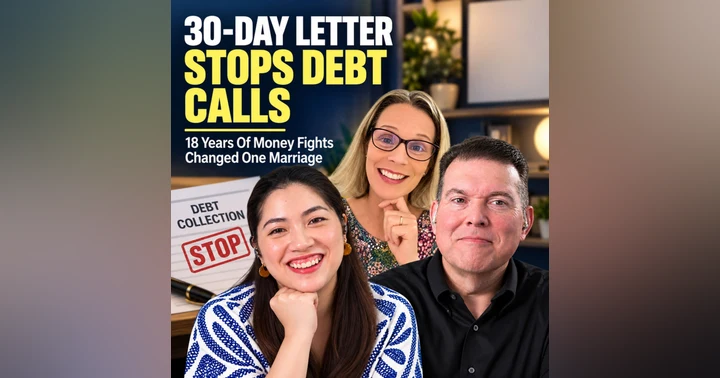
What It's Like to Be Married and Not on the Same Page About Money

If you and your spouse aren't on the same page about money, I want to tell you what that actually looks like from the inside, because I lived it, and it almost ended my marriage.
First, three quick updates that affect your wallet.
Student Loan Letter? You Have 90 Days
SAVE plan notices are going out through October. Once yours arrives, you have 90 days to pick a new plan, or one gets picked for you based on nothing you'd choose.
Log into studentaid.gov now. Run the repayment calculator. Set up automatic payments while you're at it. That alone knocks a point off your interest rate.
529s Aren't Just for College
You can now pull up to $20,000 a year for K through 12 expenses like tutoring and test fees. Leftover funds can also roll into a Roth IRA, up to $35,000 lifetime, if the account is at least 15 years old. Some states haven't matched this rule for state taxes, so call your plan administrator first.
"No Tax on Overtime" Has a Catch
Only the overtime premium is deductible, not the whole overtime paycheck. $30 regular rate, $45 overtime rate? Only that $15 difference counts. Employers now have to break this out on your W-2, so filing should be cleaner this year.
What I Never Told My Wife
Here's the part that's harder to write.
I thought we were fine because I handled the money. Handling it and being partners in it are not the same thing. My wife had no idea how much I was struggling, because I never told her. Credit cards climbing. Robbing Peter to pay Paul. I kept it all to myself because in my head, this was my job, no questions asked.
It wasn't only the money. I was controlling. Verbally hard on her in ways I'm not proud of. Never physical, but still damaging. And underneath it was my own fear, because I wasn't saving for retirement the way I should have, and I wasn't giving her any real security.
This wasn't even my first time. My first marriage ended over money too. When my first wife told me she'd need to stop working for a while, I went out and bought a motorcycle. She asked if I even cared. She was right to ask.
The day my second wife said she was leaving, I let her go. We separated. Both moved on. Two days before our divorce was final, I called her. Neither of us was doing well apart. We got back together in 2019. This week we celebrated 26 years married. Some of the damage from those years never fully goes away. I'm not going to pretend otherwise.
What changed things was one question: "What is it about our finances that bothers you?" She told me she was scared about retirement, since she had no income of her own. So I put her on payroll and committed to maxing out both our retirement accounts every year. Seven years running now.
I still have a master's degree in finance and I still don't have all the answers. I'm still an impulsive spender. My wife is the saver. Some weeks the compromise works better than others.
A few things that help:
- A 20-minute money check-in every week, just talking, no deciding
- A dollar amount where you check in before spending
- Some no-questions-asked money for each of you
Being the one who handles the money isn't the same as being on the same page. That's the thing I wish I'd understood 26 years ago.
Got questions? Drop them at becomingfinanciallyconfident.com.

Licensed Public Accountant
Ralph V. Estep, Jr. is a Delaware-based Licensed Public Accountant (LPA), author, rancher, and media host with more than 30 years of experience in finance, taxation, and small-business leadership. As the founder of Saggio Accounting+PLUS and the creator of the Ask Ralph Media network, Ralph helps entrepreneurs, creators, and everyday families replace money confusion with clarity, confidence, and practical next steps — without shame and without hype.
Ralph's work blends deep professional expertise with a coach's mindset and a communicator's heart. He has held leadership roles across public accounting, financial institutions, law firms, and technology organizations, bringing a rare combination of traditional accounting rigor and modern systems thinking to the people he serves. A graduate of the University of Delaware and Wilmington University (MBA), he is known for turning complex money topics into simple, repeatable frameworks that help people make wiser decisions and build lasting financial stability.
He is the host of Becoming Financially Confident, a live weekday show built on a single conviction: most money stress is not a character problem but a systems problem, and shame is what keeps people from fixing it. The show grew out of Financially Confident Christian, which Ralph hosted for more than 1,200 episodes across eight seasons and earned national recognition. The new show offers the same host and the same feed, opened up to a wider audience.
Through Ask Ralph Media, Ralph hosts several other programs. Grit and Growth Business… Read More

Mortgage Rates, the New 1099 Rule, and Who Owes Debt After You Die