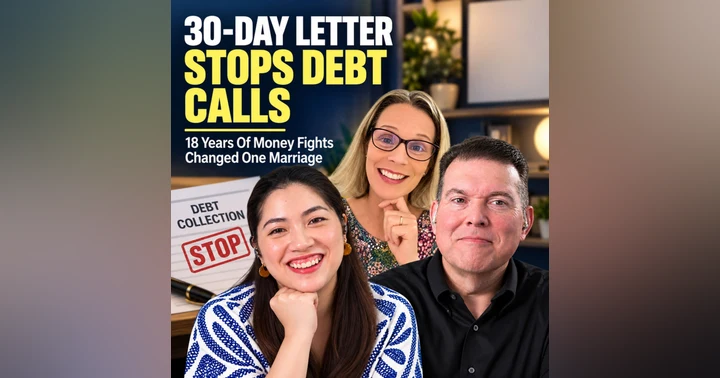
She Finally Understood Why Her Husband Was Fine With Debt

 Spotify
 Apple Podcasts
 YouTube
 Rumble
 Amazon Music
 Podurama
 Happy Friday! Before you sign anything with a debt collector on the phone, there's a letter that can stop them in their tracks, and there's a tax deadline this week that catches self-employed people who've never owed one before. Plus, marriage and money coach Karen Hackman joins me to talk about the 18 years it took her and her husband to get aligned on money, and what finally changed it.
I'm Ralph Estep Jr., a licensed public accountant with 30 years in the business, and I'm joined by my cohost Juliet. We're live every Monday through Friday from 11:30 AM to 12:30 PM Eastern on Becoming Financially Confident.
Here's what we got into today:
- A debt collector can call you seven times in seven days, but on the eighth call federal law says they've gone too far, and I walked through the 30-day written dispute letter that makes them prove you owe the debt
- If you're self-employed or get 1099 income, your estimated tax payment is due Tuesday, September 15, and I explained why the IRS penalizes you for not paying as you go
- Employer health insurance costs are projected to jump 8.2% next year, the biggest increase since 2003, so I talked through what to actually look at during open enrollment
- I shared why I love WalletHub for tracking spending and catching credit report errors, since the FTC found 1 in 4 people have one
- Karen Hackman from Money and Marriage joined us. She was married 18 years before she and her husband Wayne got on the same financial page, and she walked us through sinking funds, how a $4,000 credit card balance turned out to include two years of fraud nobody caught, and how she's teaching her daughter Charlotte the same lessons
Got a money question for me? Send it to me at becomingfinanciallyconfident.com/. Or come watch us live every weekday at becomingfinanciallyconfident.com/live.
Have a great weekend, everybody.
Links mentioned in this episode:
becomingfinanciallyconfident.com/wallet
Karen Hackman's booking calendar link
Follow us on our socials:
Companies mentioned in this episode:
- YouTube
- Money and Marriage
- WalletHub
- Federal Trade Commission (FTC)
- Internal Revenue Service (IRS)
- Vanguard
- Fidelity Investments
- Amazon
- Amazon Prime
- Airbnb
- Booking.com
- The Walt Disney Company (Disney)
00:00 - Untitled
00:13 - Introducing Karen Hackman — Money and Marriage Expert
10:21 - Guest Segment: Karen Hackman on Money & Marriage
16:05 - Uncovering the Emotional Roots of Money Conflicts
29:16 - How to Start: Scheduling a Call and the Coaching Process
45:29 - Weekly Wins & Show Wrap-Up
Ralph Estep Jr.
Yesterday I told you about the years my wife and I were not on the same page about money.And today we're handing the hour to somebody who does this work for a living, somebody who spent 18 years on the wrong side of it on her own house before she fixed it.
Juliet Chuang
Karen Hackman runs Money and Marriage. She coaches, coach couples through exactly this.And before she gets here, we're going to go through three headlines, including a letter that costs a stamp and can stop a debt collector cold, and a tax deadline on Tuesday that catches people who have never owed one in their lives. So bring your questions. This is one where you can get an answer from somebody who has done the work herself.
Music
Becoming financially confident.
Juliet Chuang
Welcome to Becoming Financially Confident, where we break free from money shame, one conversation at a time. We're live every Monday through Friday from 11:30am to 12:30pm Eastern.
Ralph Estep Jr.
Yeah. Before we get into today's show, I want to take a moment.25 Years ago this morning, September 11, 2001, nearly 3,000 people left home for what they thought was an ordinary Tuesday.Those were office workers, flight crews and passengers, firefighters and police officers who ran towards those buildings while everybody else was running away. 25 Years is long enough that some of you listening right now weren't even born yet. And that's exactly why we say the day out loud today.So today, I want to encourage everybody. Just take a few seconds with me. Remember somebody and call somebody today that you love. Thank you. Now, let me introduce myself.My name is Ralph Estepp Jr. I'm a licensed public accountant. And. And if you hear sirens going off in the background, today has been one of those days.It went to go live on YouTube, and YouTube said no. And now my fire alarm here in my office is going off. Everybody's safe. But if. I apologize if you hear the beeping, but go ahead, Julia.
Juliet Chuang
And I am Juliet. I'm just a regular person because I have a lot of questions about personal finance, and I'm sure you have them, too.
Ralph Estep Jr.
Yeah. We're two very different people having conversations about the things that affect our money.Now, we've got two house rules that all of us have agreed to. Our house rule number one is there's no shaming anybody about money. What happened yesterday happened yesterday, and today's a new day.And nobody on this show is gonna be judged for what they didn't know. Our whole goal of the show every day is to help you make better decisions. And we're gonna give you the tools to make those better decisions.
Juliet Chuang
And you know, this show is just started and we're building our community and seeing like what direction we should go in. Ralph and I, we have a lot of ideas, but we definitely want your input.So if you have any questions of what you would like us to talk about or you want to share your personal finance story so we can chit chat it about on air, please send them to us@becoming financiallyconfident.com. Nothing is off limits.
Ralph Estep Jr.
Yeah. Wherever you're on your financial journey and it is a financial journey, I want you to know you're not alone and we're here to help you.Starting today,.
Juliet Chuang
The first headline today, we're going to talk about debt collectors. So did you know a debt collector can call you seven times in seven days, all for one debt?And then on the eighth call, the federal law will presume that they have crossed a line. But there's something, there's a second thing in that same law that almost nobody knows about.If you dispute that debt in writing, Within 30 days, they will have to stop collecting until they prove you owe it. Ralph, talk us through this. I have never heard of this. So tell me more.
Ralph Estep Jr.
Yeah, so what we're talking about here is something called the Fair Debt Collection Act. And basically it works like this. If someone is calling you, you have the ability to say to them, hey, I want you to give me this in writing.This is a, what they call a 30 day written dispute.And what it does when you say this, so you can say to them, give me your name, give me your address, you can send them a 30 day written dispute letter. And what that does is it stops the collection right away.And they cannot call you, they cannot harass you, they cannot bother you until they mail you verification. Now, it doesn't erase the debt, I want to be clear about that. It doesn't erase the debt, but it makes them prove it to you.So if you've got your, your, your fares in order and you're like, wait a minute, that's not correct, that's not me, they're going to have to prove it to you. So here's the thing. Make sure you do it in writing. Do it within the first 30 days.And one other tip I'm going to give you is send it certified mail with receipt. That way you can prove that you sent it and you can prove that someone on the other side got it. That's a really important part of that.
Juliet Chuang
And so this one, you don't really need to have any legal assistance to write this letter, right? There's no formality about that. You just have to say, hey, I want you to prove to me that I have debts open with you.
Ralph Estep Jr.
Yeah, exactly. Because what this becomes, it becomes an issue of harassment. And they're honestly at that point harassing you.So it's one of those things where we've got to get to a point where we're not going to allow them to harass you any longer because they, that is just not cool when you're being harassed.
Juliet Chuang
So just know that for everybody, if you are being harassed by a debt collector after seven days, on the eighth time, you can ask them to put in a written dispute, hey, show me that I owe you money. And then if they don't get back to you within 30 days, then it can be canceled.
Ralph Estep Jr.
Well, you can actually ask this right away. You can do. Should do this on the first call. So it's just if somebody is calling you every day, you can do it on the first call.You get that first debt collection call, you just say, hey, something simple. You need to address this right away in writing. And that's what we can do. How about we move on to our second?
Juliet Chuang
Sounds good.So if you are someone who gets 1099, whether it's through freelance work, a side hustle, self employment, or even a big investment gain, the government expects a payment from you this coming Tuesday. Nobody's gonna mail you a bill for it, Nobody's gonna remind you, but if you miss it, you're gonna have to pay a penalty.So, Ralph, let's talk about this one a little bit more.
Ralph Estep Jr.
Yeah, and we've got. And I forgot I've been. This has been a day. I'm gonna tell everybody watching this, Karen Hackman has joined us.We'll talk a little bit about her in a few minutes. But I wanted to bring her into the discussion as well. So I apologize. We've got alarms going off and things aren't working.But what we're talking about here is this is the thing that blindsides a lot of people. It doesn't blindside the person who's had a business for a long time. This generally blindsides that person that this happened to the first time.Or you just realize that you're in business for yourself. What we're talking about here is when you work for somebody else, when you get a paycheck, they withhold taxes from you.But when you work for yourself, you got to do that yourself. And a lot of people don't know about that. Now that in general just means that when you go to file your tax Return.If you're in the United States in April, you may owe some money to the irs. Here's the part that people don't understand.The IRS wants you to pay them as you go and they will charge you a penalty throughout the year if you don't pay them as you go. There's a whole bunch of other reasons that you cannot do it. There's a thing called safe harbor depending upon how much you owed from the prior year.But the big tip today is if you're self employed, be aware next week, September 15, is the next estimated tax filing coupon deadline. So if you are self employed, take a look at this and decide if you need to make a payment or not. It's really quite that simple.Did you have any questions? Juliet?
Juliet Chuang
Not for this one.
Ralph Estep Jr.
Very good. Well, let's move on to the next one.
Juliet Chuang
Health care open enrollment is coming up. Employers are projecting their health costs will go up 8.2% next year. And that's the biggest jump since 2003.Most of them have already said out loud what they plan to do about it, which is hand a bigger share of that cost to you. Ralph, open enrollment is coming very, very soon. What should somebody be looking at when they're. That they're probably not.
Ralph Estep Jr.
Yeah, and this is the thing reason I want to talk about this today because what they're basically telling you is hint, hint, nod, nod, health care prices are going up. So if you even are covered by your employer, there's a good chance they're going to pass along that additional cost to you directly.So what that means is in October, this is the time to shop within your own plan, talk to hr, see what other premium are available, see if there's a way to reduce that cost. Because here's the thing that's going to happen. Your price is probably going to go up. The cost of healthcare in the United States continues to rise.If you pay a portion of it, if your employer pays a portion of it, maybe you have a spouse or children that are on the plan or all of those things are going up. But there are things that you can do to prevent that. You might go to a different tier within your insurance.You may expand your deductible, maybe increase your co pays. There's all those type of things that you can do. Again, this is one of those things where be aware of it.I'm not trying to alarm anybody, but you know it's going to change things and if you don't do anything, they're going to probably keep you in the plan you're in, and you're just going to notice that the price is going to go up, which is never a fun place to be.
Juliet Chuang
Makes sense. I have no questions here.
Ralph Estep Jr.
Very good. Well, let's move on to the next thing, then.So let's talk about WalletHub, because one of the things that I always talk about is where did you spend your money last week? That's the key to this thing. A lot of people don't know where their money goes, and that's why I love WalletHub. WalletHub does two things.It allows you to track your spending. The other thing it does is it help you find issues on your credit report.Because here's the thing, the Federal Trade Commission found that one in four people have an error on their credit report, which means that you are paying too much for loans. So that's why we've got this relationship with WalletHub. It's absolutely free. It's not a trial. It's free. And your credit score updates daily.And it tells you plainly what's pulling a number down.So if you're interested in finding out more information about WalletHub, go to becoming financiallyconfident.com Wallet Again, that's becoming financially confident.com Wallet. It's really a great service. So check it out.
Juliet Chuang
So our guest today here we have on screen is Karen Hackman. She's a finance coach who works with couples. She runs Money and Marriage.And she is here because yesterday Ralph told you what it cost him to not be on the same page with his wife. And, Karen, does this work with couples? Over and over professionally. Karen, welcome. I want to start where you started.You were married 18 years before you and your husband got on the same page about money. What were those 18 years actually like?
Karen Hackman
Very frustrating when I look back in it. First of all, thank you for having me. I'm so excited to be here with you guys.So, yeah, it was very frustrating because I am a saver and my husband is naturally a spender, and I just presumed that he would have the same attitude towards money that I did, and he didn't. And every time we. I brought up money that I wanted to talk about money, I had some plans, I had some ideas. They would always end in an argument.Juliet. And it was just a vicious circle.And so eventually we didn't talk about money until I saw something on YouTube and I thought, wow, this person is talking common sense. He's, you know, we were spending more than we earned.And even though we, at the beginning, we had marriage prep classes at our church, we had marriage mentors, and we had a financial advisor. Nobody told us the basics about money. The things that now seem like common sense, but sadly, common sense isn't so common anymore, is it?So, you know, we were just so frustrated.So when we did get on the same financial page we were, and it took me a long time, Julie, I have to say, when I realized that we did need to talk about money, I spent three years researching, reading books, listening to podcasts. How can I speak to my overwhelmed and reluctant husband about money without it turning into an argument?And then when I did, and we were able to talk about money without slamming doors, Amazing. It changed everything. And it doesn't just impact your finances, it impacts your marriage as well. And all for the better.And because I know what a game changer it is, that's why I'm so passionate about helping other couples so that they don't have to go through what we went through.
Juliet Chuang
Can you share a few stories of, like, things that you tried, but it maybe like the communication style wasn't for you and your husband? Because every single partnerships have different communication styles. Right. So can you give us a little bit stories?
Karen Hackman
Yeah, absolutely. So my husband is a night owl, and I am an early bird.So by the time he has woken up, I have been awake for two hours and I've checked the bank balance and I've seen something that I don't like. And so I would go into the bedroom, here's your tea. And what's this? What's this? And what's this coming out of the bank balance?And so obviously I know now that's not the best way to approach someone when you want to talk about money. So.
Juliet Chuang
Yeah.
Karen Hackman
So I highly recommend that you approach them when they're in a good mood and when they're awake.
Ralph Estep Jr.
Let me ask a question there. So when a couple sits down with you for the first time, Karen, what's the thing they discover about each other they didn't already know?Because I think that's what you usually find is like it's one of the things that they didn't know about. What. What have you seen in your work?
Karen Hackman
Yeah, it's amazing that we say we explore their money stories, where their attitudes to money have come from. So I always say that you come from two different families and then you are becoming a new family. And so. And.But you still have these stories of how you grew up.You know, Ralph was talking about yesterday how his mum and his dad had, you know, two different ways of spending their money because of different circumstances.And then so when you come together, if you understand where each other's coming from, it's amazing because I understood that my husband, when he was a young boy, he had a paper round, and his dad, if he wanted something, his dad would buy it for him. And then every week, he would pay, like, a few dollars back. And then for me, my dad taught me, don't leave yourself short.Which means, you know, have a look at your money and make sure you don't spend it all before your next paycheck. And then when we realized this, my eyes opened and I was like, wow, that's why you're so okay with debt, because you've. That's what you grew up with.Right. And it's just bringing those two stories together, understanding where each other's coming from, so then you can find a new way together as a team.
Juliet Chuang
Yeah.So part of that, it really sounds like, okay, being aware of where your partner is, what their stories are, and then have you found through your work, you know, in your own marriage as well as other couples, it's like they're trying to build a new money, financial habits and financial stories together. Is that something that you find most often?
Karen Hackman
Yeah, absolutely. Because Julia and Ralph, as you appreciate, no one trips and falls into wealth. Right. You have to.
Ralph Estep Jr.
Not usually. Unless you hit the lottery. And then that maybe happens, but that doesn't happen very often.I guess you got a better chance of getting hit by lightning.
Karen Hackman
Absolutely. Absolutely. So, you know, so when you are.When you're able to talk about money and dream about money, what you want to do, you know, you'll do vacations that you want to go on, or maybe send their children to private school or pay for their, you know, help them out with their university and college fees. You know, it just. When you've got that plan and you're working together, you.You are holding each other accountable in a loving way, and you're also supporting each other when it goes wrong, because obviously sometimes it will. And, you know, these things happen. But if you are intentional and you're talking about it and you're supporting each, that.That's like a whole game changer.
Ralph Estep Jr.
So let me ask you a question, Karen. Do you think there's something underneath the money argument that really is triggering most of these things?Because I really believe that, by the way. I think there's something underneath. It's usually it's not the money, it's not the math, it's something underneath it, like an Emotional issue.
Karen Hackman
Yeah, absolutely. And some of the clients that I work with, they've never spoken about it before, and they're. And there may be feelings, you know, that some.Some couples I work with, one of them comes from kind of like, they've been happy to be really strategic with their money. You know, their mums and dads haven't had the wealth that they wanted, and so they've been from kind of like, less affluent families. And so.So, like one couple I worked with a few weeks ago, he didn't understand why the wife just wanted to sit down. She made the budget. She just wanted him to sit down and have a look at it.And because when she grew up, her family didn't have extra cash, so she was worried about security. She just wanted to feel secure. And then that light bulb, light bulb moment when he's like, ah, I get it. This is why it's so important to you.And that, you know, the whole atmosphere in the room kind of changes because he's. He loves his wife and he wants to, you know, make her happy, and now he knows why.And so, you know, they're sitting down once a month, having a deep dive, looking at what's coming up, not what's gone, what's coming up. And they're creating a plan together, and they leave feeling excited and hopeful about the future, which makes my heart sick.
Juliet Chuang
Yeah, that kind of like, calls back to Ralph's story yesterday where, you know, he said, you know, I finally shut up and listen to my wife, and I understood. I understood why she felt this way about money, and I understood where I could have done a lot better.
Karen Hackman
Yeah, yeah. All about listening, isn't it? You know, listening to understand.
Ralph Estep Jr.
That was the big thing that came down for me. Not to interrupt you, Juliet, but that was the big thing that came down to me is like I was listening, but I wasn't listening to understand.And I would just want to trumpet what you just said there, Karen, because I was listening out of obligation, you know. Oh, okay. What do you have to tell me this time? Okay. But I wasn't listening for what the pain points were.I wasn't listening for those struggles that she was trying to tell me. And when I finally said, okay, this is about security. This is about feeling of worry, of overwhelm.That's when I was actually able to do something about it. But I didn't mean to interrupt you, Juliet. Sorry about that.
Juliet Chuang
Oh, no, that was such a good segue into the question that I wanted to ask Karen, which is, you know, the first time two people start to really talk about money, there's bound to be, you know, it's like fighting heads, being like, I don't know what you actually want for me and all that. How do you, what advice? Or like, how do you coach people, couples through those first hard discussions?
Karen Hackman
Yeah. You have to give them space to talk, you know, and then say to like with a one spouse, just listen, just for a moment, just listen.And then it all comes out.And then, you know, and as Ralph just said, listening but not really listening, you know, are you listening to really understand and then that just helps them and then they offload and all of this like pent up frustration just comes out. And we say that there's no judgment here, right? There's just you feel how you feel. But we're here to move forward and to make a new plan.So it's just, we're very non judgmental, you know, no shame. Just come as you are and let's see how we can move forward.
Ralph Estep Jr.
Now.Karen, one of the things I bet is really hard and this is before they can even get to the point of talking to you, do you mostly get one partner that reaches out and says, ah, you know, I, I hear what you're saying. It took 18 years for you and your husband to get on the same page. I can't.And I'm not throwing husbands under the bus, but I can't get my husband to even come to a meeting like this. I can't get my husband. How do you deal with that when somebody is shutting down before they even get started?Because I know you and I've talked in the past in full disclosure. And that's gotta be the hardest part, isn't it Karen? Getting two people to even agree that we have a conversation in the first place.How have you made that work?
Karen Hackman
Yeah, well, we've. So it is mostly the wives that come to me and say, look, you know, my husband's in charge of the bank account. I don't know what's going on.And then I go shopping and then it gets really cross with me because I've spent too much time, but he hasn't told me how much I've got to spend. So I normally, the wives normally go to the husband, say, look, this is really important for me. Can we just jump on a call with Karen? 15 Minutes.There's no obligation. You're not agreeing to buy anything. You're not agreeing to, you know, to sign up to her like coaching program.Just, just, it's really important to me. Can you please just give me 15 minutes? And then they get on. They get on and then we have a chat and they're like, okay, let's, let's, let's do this.Let's give it a go. We've got nothing to lose and so much to gain.
Juliet Chuang
Yeah, yeah.So then I'm sure in those first couple of conversations that these couples have with you, they may talk about how much debt they have or like resentment towards what's being spoken or being not being spoken. And so there's a lot of tension in that, like, first meeting. Right.Where they're facing their financial situation verbally for the first time, and then they're doing it with somebody who's not, you know, part of the relationship. Which one do you deal with first? Is it debt or resentment or is it something else?
Karen Hackman
I think it's the resentment first. And then we can, we can say, look, the past is in the past now. You know, we just, we're here, let's just get everything on the table.And sometimes there is hidden debt that comes out that the husband or the wife didn't know about. And we're like, look, we're not here to have an argument, take a deep breath. This is how it is. You know, we're being open and honest now.We've come with a non judgmental attitude. Just deep breath. Let's, we can make a plan. And they leave with hope, which is just one of the things that I love, because nothing is impossible.Yes, it might be a few years of hard work to get out of the debt. You know, a few years of saying, no, we can't have that lovely five star vacation in Florida or wherever you would like to go, you know, and then.But then the future looks so much better than the past. And I think, you know, sometimes if couples are worried and anxious, just jump on a call with me and we can make a plan together.Because it's better than sitting there stewing for another six months, another year.
Ralph Estep Jr.
Karen, I want to get back to you and your husband.
Karen Hackman
Yeah.
Ralph Estep Jr.
Because I think this is the thing that a lot of people can relate with. So what I'm picturing here, and correct me if I'm wrong, is that you were anxious a lot. You wanted to have a conversation with your husband.I really want to talk to him about this. You mentioned earlier, you got to find the right time. How did you find the right time? And how did you finally get even the.Because I almost pictured, like, we got to have a summit first. Like we got to agree to talk first. So in your own relationship, how did you make that work?If you're willing to share it, and I'm sure you are, you've been very honest in your blog and on the, on the social media things. But how did you make that happen first with your husband Wayne, to where you're like, dude, you're going to listen to me.
Karen Hackman
Yeah, well, it was hard at first.And then I learned that, you know, when he was singing, because if he was singing, he was in a good mood, I would say, and he knows this now, and I'm giving away all my secrets. He. I said, look, you know, I really was thinking, you know, like years ago, I said, look, can we. I'd love to take our daughter to Disney.Can we, you know, sit down and make it happen and just have a look at the numbers to see where we are? And can we meet on, like, Saturday, Saturday morning, grab a coffee?My top tips would be don't sit down when you've got people coming or you're due out, due to go out, because you don't need that extra stress of the time. And then just make it really short. I learned to have, like, the. The numbers on a notepad. Just, just. I've done the work. This is what I'm seeing.This is what we could save every month. Could we make it work? And the top tip is to make it super short.If your spouse is overwhelmed or reluctant to talk about money, they do not want to sit down with a spreadsheet for 90 minutes. Yeah, just keep it super short. Show them the numbers or what you're thinking. This is how we can make it work. What do you think?And then have something fun planned afterwards, like go out for a coffee or go out for a walk just so they know mentally that you're not going to be sat in it all day.
Ralph Estep Jr.
So you started off with a. From a place of awareness, I think, and you had to go find the awareness, because I don't.I think what I hear you saying is your husband wouldn't have gone and found that awareness. So you feel like. And don't let me speak for you, but you went and figured out just what's going on first.So if somebody right now is listening, one of the things that I think I hear you saying, the first step is go figure out where you are, put together the numbers first, develop a point of awareness, and then come alongside your spouse and say, hey, honey, here's what I found. Have you ever thought that?Can you believe we spent this much not to be accusatory, but as I looked at this, I realized, here's where our money's going.
Karen Hackman
Yeah. And it's amazing what people find out. And now when Wayne and I first started talking about money, he had credit cards. I knew about them.I did not know the numbers. I knew pretty much they weren't going to be good because that's why I didn't want to talk about it.And because I would pay off my credit cards in full at the, at the end of every month. Yeah. So that was, you know, and it comes for me. I was. It took me a while to understand why people didn't do it the way that I do it.You know, not everyone's the same. And I'm like, okay, this is, this is what happens. I've got to take it, know it, know about it, support him in being non judgmental.Because I have to say, I got that wrong at the beginning. Right. I was like, hold on a second,.
Ralph Estep Jr.
Hold this, hold on a second. I want to make sure what I just heard. You had to admit that you made mistakes yourself.
Karen Hackman
Oh, 100%, yes. Yeah. No, And I think.
Ralph Estep Jr.
And that's the thing that I learned. I had to go back and really revisit the fact that, Ralph, you don't know all the answers.Even if you have the master's degree in finance, you don't know all the answers. So it seems like you went through a similar journey.
Karen Hackman
Yeah, absolutely.And I was very much the control freak, and I was treating him like a child, and I was the adult, and I had to really step back and go, no, that you cannot do. That's why he's running away, because you're treating him like he's a three year old. You know, So I had to really.I had to really mentally just, you know, really be prepared. Right. What are you going to say? Deep breath. Don't show him that you're like, what? How much have you got on that credit card?You know, and how much interest are you paying? Because that was the killer. The killer was. Yes. He had like $4,000 on one card, but the interest was $100 a month. And I'm like.And when you could realize that it was right. I don't really want to be paying these people $100 a month of my hard earned cash. So let's make a plan. Let's get rid of this.Let's pay this down as quickly as we can. Yeah. And also, you know, when he first showed me that statement.
Juliet Chuang
Yeah.
Karen Hackman
Within 30 seconds, I knew Something was wrong. And. But because he was so overwhelmed with his credit cards, he would not look at those statements. It was just.He was just paying off the minimum every month because he couldn't afford to do anything else. And you know what we discovered by two years, there was fraudulent activity on that card. Two years. We had two. Yeah, two Amazon prime subscriptions.They were subtle. It was take 7.99, 399, and it was all adding up. And it was just before Christmas and I saw 71 99. And I'm like, what. What people buy when I. $72.And it's like, nothing. And I'm like, you need to sort this out. And I have to say, the credit card company and Amazon were brilliant. So.But that's one of the reasons I say to my clients, it's really important that you look at these statements every month.
Juliet Chuang
Yeah, that's a good reminder for me because I think you hit on. Exactly.Like some people, they don't look at their credit card statements because they just have overwhelming feeling in whatever situation they're in. But once you.Once everybody can get to that point of being like, okay, I'm going to brace myself, I'm going to look at the number, I'm going to face it. And then. And then you can have a plan. Whether you're individual or in a couple or not.Like, that is probably the thing that will set you on the path to financial freedom.
Karen Hackman
Yeah, absolutely. And as I said earlier, looking at those interest rates, how much money you're paying in interest, that was really like the.The bullet that we needed just to get going, you know?
Ralph Estep Jr.
So let's talk about the process so someone reaches out to you. We're going to share with the audience. There'll be a link where they can schedule a remote call with you. Because just so you.If you don't know, Karen actually is in Kenya. And Karen, you could talk a little bit about what you do there, because I think it's really kind of amazing what you and your husband do.Do you want to share that with the audience?
Karen Hackman
Yeah, sure. So my husband is a pastor in an international Christian boarding school, and we came out here 11 years ago.Before that, we were in Bermuda for six years and we were only supposed to have left the UK for three years. Our daughter was 18 months old and now she's 17.
Juliet Chuang
Wow.
Karen Hackman
So, yeah, Crazy.
Ralph Estep Jr.
So there's a lot of compromise there, too. So you've learned compromise from other directions as well?
Karen Hackman
Yeah, absolutely. Well, I have to say, when we were in Bermuda.Well, when we were in, back in the UK and the, the job for Bermuda came up, it was because I, because my husband was a youth worker. I had to go back to work when our daughter was five months old.And you know, I was working as a primary school teacher at the time and it was long hours, you know, I'd be leaving the house at 7 in the morning and then working marking books till 10 o' clock at night. And then. So when Bermuda came up, it was like a chance for me to be a stay at home mom.And that was like a real godsend because as you know Ralph, I'm not sure Juliet, if you've got any children, but these kids blow up so quickly, you know, and you want to spend some of the, make some memories with them, you know. So that was a, that was a godsend.
Ralph Estep Jr.
So the process starts with a phone call you get on Karen's schedule, then what happens next? Karen?
Karen Hackman
Yeah. So we have a little chat on the phone call. Let's see where you are now and how I can support you.And then one of my favorite coaching programs is called Financially Thriving Marriage. And it's a five week coaching program and it's something that I designed, something that I wish we'd had 20 years ago.You know, just five weeks of looking at where you've come from, looking at where you want to go, you know, looking at where you are now and how I can create a plan to help you get there.And it's just some great conversations in that non judgmental space just for newlyweds or if you've been married for a few years, you know, I've just had some newlyweds to come on board and they were like, these are conversations about money that we would not otherwise have had.And then I've had, you know, couples that have been married for over 13 years saying, wow, we know this just we're so excited about our future now because we're both, you know, we're singing from the same hymn sheet. We are both on the same page. We know these are our goals. We've always talked about going to Japan, but never really done anything about it.So now they've got like a, a little money pot where they're saving a little bit of cash every month knowing that maybe in a few years time they're going to be able to go to Japan, whereas before what they've just spoken about it but done nothing about it.
Ralph Estep Jr.
And I love that because one of the things that we've talked about on this show is I actually don't like the word budgeting. And I, and I stole your word. In full disclosure, when I first started talking to Karen, she said an intentional spending plan.And I have embraced that.But one of the things that I think when a lot of people hear the word budget, and I can only imagine when you're doing couples counseling, most people hear restriction, most people hear diet. But I love where you went with that because it's one of the things. I'm writing a book about this called the Dollar Job Framework.And the thing I think you start off is with the dream. And I think that's what you were just talking about. So do you work with that in your, in your work? You know, what is the dreams?What do you see yourself doing with your money? Is that part of your process as well?
Karen Hackman
Yeah, absolutely. Where do you want to be in 5 years time? You know, initially, sometimes we just talk about where do you want to be in the next month?You know, so it's really hands on, very practical, very, you know, very goal orientated, you know, and I always recommend that my clients have like a piece of A4 paper with the word why in the middle.And then like for us, when we were going to Disney, it was pictures of Disney and Cape Canaveral and the Florida beaches, because that was our why and it was pinned all around the house. And this is what I encourage my clients to do because it's the motivator. Right. You know, you can see it, right?
Ralph Estep Jr.
There's a vision. You can see now what is an 84 paper? I apologize, I don't know what that is.
Karen Hackman
A four. A four.
Ralph Estep Jr.
Oh, a four.Now I understand what you're saying, but, but what you're doing is you're building the vision and you're, you're encouraging them to put the vision all around them. That way as they're making those daily decisions, they see why they're making their decisions.
Karen Hackman
Yeah.And a great thing about it is that when you get family or friends come around to visit, they see these posters and they're going, what's, what's with the why? What, what's that all about?And it's a great discussion, you know, a conversation starter because, you know, this is our dream, this is what we want to do. We're going to, we've got a little bit of debt.We want to get rid of that right now, you know, but this is our long term goal, this is what we're reaching for. And then it's amazing how many people say, oh yeah, you Know, you know, we've got a bit of credit card debt, you know, so we want to, you know.And so it all comes out in the open because I don't know about you guys, but not a lot of people in the UK like talking about money. It's a very, like we don't talk about money. And I think my friends in America, I think you're a bit more open to it than we are.But it's, you know, when you have. So people say, oh, do you want to go out? Let's all go out for a meal on Friday night. And you can honestly say, I can't do it this week.Why don't you all come round, you know, bring your own. Bring like a bring and share. You call it a potluck, is it?
Ralph Estep Jr.
Potluck, I like that term. Yeah. Potluck meal.
Karen Hackman
Yeah. So and then.And it's amazing how many people say, oh yeah, you know, we overspent last month or you know, the credit card bill is getting a bit too high. So it's always conversation starters and just making. Got you aware that you are not the only one.
Juliet Chuang
I want to bring in a comment from the chat.
Karen Hackman
Kate.
Juliet Chuang
I feel like my DH dear husband, we learned that acronym yesterday and I waited too long to make plans. However, we did make them and are actively working towards a common goal of saving money. I love to see that.
Karen Hackman
Good job.
Ralph Estep Jr.
Yeah, I think that deserves an applause. What do you think? I think that's a good one for today. Absolutely.
Juliet Chuang
I think Karen, what you said about having an A4 paper or whatever kind of paper and put your why on there, that is such a lovely exercise that I want to do for myself too because I'm trying to get back in my own personal finance good graces and like feeling really confident again.So for someone who's being a lot more conscious for someone and couples who are being a lot more conscious about their financial well being within that first year or so, like what do you suggest that they should really pay attention to in terms of like changes or what should they notice as they go on their own financial journey?
Karen Hackman
Yeah, I think when she start creating your intentional spending plan, you're just really more aware of what you're doing with your money.You know, whether you spend, you go out for a meal and you spent $120 or you know, just you just more intense, you just go out with your eyes are open a bit more.You know, it's just like you maybe you, you know, you've cleared the mud from your eyes or suddenly you're like, oh, I didn't realize that was going to cost so much. You know, you just more. You're more intentional. So for those first few steps, I always say just find out how much debt you're in.You know, just get it all on the table. Because a lot of people don't know that.And a lot of clients I work with, 50% of the clients I work with say they don't actually know how much they earn either. So it's just opening their eyes to those things, making them more aware.And then they have, like, a little goal, a little mission, so maybe to clear the debt and then build up some savings, because, you know, you never know what's around the corner. And something's always going to come along and derail you, whether it's like the water heater's broken or you need new tires for the car, you know.And that buffer is amazing because it just saves you putting it on the credit card. And one thing that I always say as well, that have been a complete game changer for us, and I really do wish we'd known 20 years ago. Sinking funds.Yeah, it's like sinking funds for. For me, it's the dentist. And I'm back at the dentist again on Monday.And whereas before it would just go on a credit card, now I have, like, a sinking fund. Yes, I would rather spend $2,000 on a nice vacation, but it's going on my teeth.
Ralph Estep Jr.
So let's talk about a sinking fund, because, Karen, a lot of people might not know what you're talking about there. And I think it is a brilliant thing. I talk about this all the time, but explain it to the audience.
Karen Hackman
Yeah. So basically a sinking fund is things that you know are coming up. Right?So let's say you've got Christmas coming up, or you've got birthdays, or you've got car maintenance. It's things that you know are going to come up and. And you say you're saving for it. So for our bank account, we've got our main account.And then so many banks are brilliant these days. You can have a little savings pots, you know. So we have one car maintenance dentist for me, Christmas, school uniforms.And so, like, for Christmas, like last year, we spent 500 on Christmas. So we divide that, and I divide it by 11, which means that, you know, every month we put that money aside in that pot in our bank account.That's our sinking fund for Christmas.
Ralph Estep Jr.
Let me pause for a second. So when you say you put it in a Pot. Tell the elements. What do you physically do? Do you have envelopes? Do you set up a separate account?What do you do to actually move the money?
Karen Hackman
It's a separate account. So every time we get paid, we put a few dollars in each account, depending on how much we're going to spend.So let's say that the, the car maintenance, the service every summer is going to be around $1,500. So then we divide that by 11 and then put that, that much money in the sinking fund. Make car count every month.Because then when, when something goes wrong, all the, or I'm at the dentist, or, you know, the car breaks down. Wayne. And I can say it's okay, it's not a big deal, it is an inconvenience. But there's the money. We just transfer it over. So does that make sense?
Ralph Estep Jr.
Yeah. In other words, you go from being reactionary to being intentional. You made that intention. How do you get started with that, though?Like, do you go and look at what you spent last year? Because I think this is brilliant, by the way. I think I've said this on the show many times. There really are very few financial surprises, you know.You know, if you have a vehicle, it's going to require maintenance. If you own a home, it's going to require maintenance. If you are a human being, you're going to require maintenance.Like you said, the dentist, the doctor. So how does somebody go and figure out what those things are? What is the easiest way to do that? Karen?
Karen Hackman
Well, so we like, for the car, we knew around, roughly around how much it cost for a service every summer, the dentist, we just, like, I just picked a figure and then what we could afford really, to put away every month. And then for Christmas, what did we spend last year?And it's great because when Christmas comes around, that's the amount of money we've got for Christmas. And when it's gone, it's gone. We can't spend anymore, you know, and then.Yeah, and just things like that have just really helped us because otherwise, if you take it, say like, I'm going to the dentist on Monday, right.And I didn't have that sinking fund, it would just go on the credit card and it would just take us a few more months to clear it again, you know, and it's just so depressing, isn't it? But it feels empowering, you know, you've been intentional. You've got this money. Yes. It's not a problem.We can pay it off without even, without even skipping a beat. You know, we're intentional. We've got this money. That's what it. That is what it's there for.
Ralph Estep Jr.
I'm going to throw one more question your way, and then Juliet probably has a question, too. So you mentioned your daughter. So how involved have you and your husband been in involving your daughter in these discussions?Because one of the things that Julia and I talked about a few weeks ago is a lot of parents don't involve their children. And then we wonder why, when our kids are older and we shoo them out the door, time to go fly on your own. We wonder why they struggle with money.Have you done that? Charlotte is your daughter, correct?
Karen Hackman
Yes.
Ralph Estep Jr.
Have you done that with Charlotte? And have you found that to be really effective?
Karen Hackman
Yeah, really effective, actually. Because, you know, we. And this is. This is also.I speak to my clients about it, because if they're teaching their children, then the children aren't going to be in the mess that they were in. Right.And we are passionate about not teaching her, you know, that you just put everything on the credit card and worry about it later, you know, and she's actually quite financially savvy. Last summer she got a job in a pub, just like doing in the. In the pot wash, which is hard work. Right. Well, she had her own money.And she was like, oh, it was great as a parent because when she was shopping, she wasn't asking me for the cash, you know, so it was. This is her own money. And then she was. And it's got no overdraft and she's not allowed to get a credit card because she's 17. Yeah.And it's just been really good.And even when things like when we're going to Disney, if we would go out for a coffee, we would say it's a milkshake or a cake, we can't have both, you know. And so it was all about that, what it's called now, where you kind of. You're. You're saving up and then you're spending it. What's it called, Ralph?
Ralph Estep Jr.
Delayed gratification.
Karen Hackman
Yes, that's the word.
Ralph Estep Jr.
But this is, I think, a lot of kids don't get. Because we live in this. My wife calls it the instant gratification generation, where everything is instant. Just boom, boom, boom. And I.And I love what you're doing there because you're teaching your daughter choices. You're teaching your daughter scarcity. You're teaching your daughter that if we do this, we can't do that.If we do this, we can't do that, yeah, absolutely.
Karen Hackman
And, and where we live, a lot of people, you know, I don't know what happens behind closed doors, but they go on holidays to like five star hotels, to the beach and, and I'm like, charlotte, this isn't normal. You know, I don't know how they're managing and it's none of our business, but this is the amount of money we've got. This is what we can do.And even like the other day, thinking of going away in October for a few days, so I got like on the Airbnb or booking.com and, and shared with the family. Here are some ideas. What do you think?You know, and it was, it was only a few days away, you know, just, but just took for her to know, this is the money. We're thinking about the budget, we're thinking about how much money we've got to spend, which one should we choose?You know, then we're having a discussion about, well, this one's double that price than this one. Is it worth it? You know, and just weighing up all the pros and cons about it. But no, she's, she's really good.She's got her head switched on and yeah, I'm really proud of what. The decisions that she's making. So, yeah.And it's even interesting, a few years ago we went to big supermarket and she wanted to buy a little Christmas tree for her bedroom. And then she, and then she wanted all the ornaments to go on it and the tinsel and the stars and everything. And I said, oh, that's brilliant.How much money have you got? Did you bring a press? And she's like, oh, yeah, but I've only got this much money. And I knew that she wanted me to buy the rest.And I'm like, no, that. Use your money, you have to spend it. And the next thing I know she's putting all the decorations back.And I said, yeah, well what happened to those decorations? And she said, oh, we've got lots of home, mum, I don't need anything new.
Juliet Chuang
I love that she's just like, oh, because, because for her is, you know, she doesn't have a credit card right now, but if she did have a credit card, that would be an option for her. Right. But for her to already think it through and then make decision on her own and said, we already have enough. I'll just reuse. Love that.I'd love to see that.
Karen Hackman
Exactly.
Ralph Estep Jr.
Yeah.Because she wouldn't have made that decision had you not given her the opportunity to make that decision because I think as a parent, we all want to step in and go, oh, I'll take care of that. I've caught myself doing the same thing. I'll take care of that. And that's kind of the tough love part, isn't it, Karen?
Karen Hackman
Yeah, absolutely. Because. But then what we're teaching them. We're teaching them just to come and call us and you know, hand over the card whenever they want to.That's not going to help her in a few years time when she goes to, you know, university or to live on her own, you know, so, so yeah, she's doing great. We're really proud of her.
Juliet Chuang
Yeah. So something we do every single Friday.And you, because you're here on a Friday, I want to ask you, we talk about our wins of the week, will you share with us at least one win of the week and does it have to be financially related? It could be anything else too.
Ralph Estep Jr.
Hold on. Before we do that, let me do this.
Juliet Chuang
Oh,.
Karen Hackman
Karen, could I let you guys go first?
Juliet Chuang
Ralph, I'm gonna punt it over to you.
Ralph Estep Jr.
So I've caught the punt and I'm going to run with it. So my wins of the week number one is. Thank you everybody who's joined us all week. This is the end of week two and with our struggles today.And I feel really good about myself because I probably would have lost my crap for lack of a better way of saying it when YouTube wouldn't work and then the fire alarm's going off and I'm hitting the wrong buttons. So. But, but thank you everybody who's joined us this week. My win this week is having Karen on the show, number one, Karen.I've known each other for about a year now and Karen is a great person and we'll give her a minute here at the end to tell people how to reach her. But that's my win of the week. My big win of the week is. Is everybody here joining us? It's been a great time.We're looking forward to, to really do a more with this and that's my win of the week.
Juliet Chuang
Okay.For me, before I do mine, I want to shout out to because Kate, our Duchess of NJ has said in the chat, I have drilled the importance of saving money to my daughters, hoping they learn from our mistakes. They've been pretty good about hearing the lesson and I love to hear that as well.I love to see like the younger generations just be more financially savvy than we are. So that's amazing. Amazing. My win of the week yes. We made it to second week of the show.And I think the big thing is we're trying to shape this community in a way that serves, you know, that helps the community. Right.So if it's like, if you guys want to share with your kids and your cousins and your enemies and your friends like this show, and we would love to build that, and we're like, Ralph and I and the team, we're very, very excited to do that. So that would be one of the. For me, Karen, yours.
Karen Hackman
Yeah. So mine is being here with you guys. What a great way to end the week. It's great to catch up with Ralph and to make a new friend with you, Juliet.
Juliet Chuang
Thank you.
Ralph Estep Jr.
So right now, what time is it where you are right now?
Karen Hackman
It's just coming up. It's half past seven.
Ralph Estep Jr.
Half past seven.
Karen Hackman
In the evening.
Ralph Estep Jr.
In the evening.
Juliet Chuang
Oh, look at that time difference.
Karen Hackman
So it's the weekend.
Juliet Chuang
It's the weekend. Before we end the show, you need to tell people how they can find you. Let us know.
Karen Hackman
Yeah, thanks. So I have a website called moneyandmarriage.net. You can also find me on Instagram and Facebook. On Instagram and Money and Marriage two.That's the number two. And in Facebook, I am Karen Money and Marriage. And I know Ralph has very kindly said he will put a link to my calendar in the show notes today.So if you would love to, you know, get on the same financial page as your spouse and to really win towards the end of the year and to make 2027 a great start, then please do get in touch for you, or if you know anyone, family and friends, that you think this might be just something that they need, then please do that. Please do connect us and you offer.
Ralph Estep Jr.
A preliminary call that somebody could get to know you. And what does that look like, Karen?
Karen Hackman
Yeah. So it's 15 minutes. We just have a little chat and see where you are, where you want to get, get to how I can support you and.And then if I've got a coaching program that's great for you, then we can. We can just make a plan. It's no. If you book an appointment with me, it doesn't mean that you're committed to anything.We're just going to have a chat. No judgment, no shame.
Ralph Estep Jr.
Now, Karen, I know you also are a school teacher, so you'll appreciate what we're getting ready to do next, and that is.
Juliet Chuang
We're keeping Karen hostage here for now.
Ralph Estep Jr.
So one of the things that we do on the show every week, Karen, is On Monday, we assign homework. And this week's homework was to set up a PIN number with your cell phone carrier so that no one can steal your information from your cell phone.And also to set up two factor authentication on your bank account and on any other email accounts that you have. So I will tell everybody in full disclosure, I have done all of those things. So I get the thumbs up for Ralph doing his. There we go.Thumbs up for Ralph doing his homework this week. But Juliet. Let's talk about what Juliet accomplished this week.
Juliet Chuang
I have done that. Actually. This is the one that I didn't procrastinate until the very end. I did it very early in the week. Yesterday.I did mention, if y' all did not catch.Also take a look at whatever holding, like brokerage holdings account that you have, like Vanguard Fidelity, anything of the sort, because they're all starting to roll out additional security measures in case somebody tries to move money from your bank from your accounts. So that is the final thing. But that's kind of like an addendum to the homework that I'm going to do this weekend.
Ralph Estep Jr.
I. I like addendums to the homework. Karen, do you ever assign extra credit? So is that extra credit that we're talking about there?
Karen Hackman
Yeah, like, so for me, for, like, homework? Yeah, yeah, yeah, yeah. Some. Not the. I speak. Teach little children, so they're like five and six years old, so not so much.But I think two factor authentication is genius, and you must do it because so many scammers out there that could cost you hours in trying to fix it. So, yeah, it doesn't take that long to set up, does it?
Ralph Estep Jr.
And like Karen said, look at your statements. Her husband Wayne had charges on his statement.He was so overwhelmed and didn't want to look at it, but there was stuff that wasn't his, and if he had never looked at it, he would have been paying somebody else's debt. So that's a. That's a brilliant takeaway from today.And one of the things that Juliet mentioned a few minutes ago, and I just want to take a minute and talk about it for a second. This really is a community and we would love to have more people join us. If you can't join us live, that's cool.But send people a link to our show, becoming Financially Confident, and tell them about the value you're getting here. If you'd like to leave us a review, that'd be fantastic. Tell everybody about what we do here. Share it, because we're going to help people.My goal every day when I get up in the morning and is how can I help people get to a place of doing a little bit better with their finances? Because, listen, as I've shared on this show, this is a journey for all of us.I've been in the same places you've been, maybe not in the same particular places. You know, I shared my story yesterday.This is not easy stuff, but if you have somebody that will help you, if you have somebody that will show you a better way and use this as accountability, too, you know, that's why we do the homework every week. So that's really it for today's episode of becoming financially common. We are super happy that Karen was able to join us. Karen, thank you so much.You have this special place of being, our truly our first guest on the show.
Juliet Chuang
Yes.
Karen Hackman
So excited. Thank you so much for having me.
Ralph Estep Jr.
So I'm Ralph Estepp Jr. And I'm Juliet.And if you've got a question you'd like us to talk about on the show, we are actively building the show for next week and the weeks beyond, and we'd love to hear from you. I must drop one more thing. One of the coolest things you can do.If you'd like to actually leave us a voicemail, it is super simple to do, and I would love to hear your voice. And Juliette would as well go to becoming financiallyconfident.com voicemail.Just go directly to that link becomingfinanciallyconfident.com voicemail and just follow the instruction on screen. Hit record, and you will hear your voice on the show, and we will answer your question. That's what we do here.It's all about answering your questions on the show.
Juliet Chuang
All right, I think that is it for today. Thank you so much again, Karen, for joining us. And I'm so glad to have met you today, too.
Karen Hackman
Pleasure. Thanks so much, guys. Have a great weekend.
Ralph Estep Jr.
So as we close out, this is becoming financially confident, breaking free from money shame. One conversation at a time. And we will see you again on Monday. So everybody have a very great weekend, and we will see you again soon.
Karen Hackman
Sam,.